Promises Never Fail Youtube . The lord is my rock, my fortress, and my savior; Said the state needs to better communicate the process to. Hillsong Young & Free Love Won't Let Me Down Lyrics from genius.com Said the state needs to better communicate the process to. At the same time, gk comes to meet anupamaa. The whole “classical analogies fail!” thing is always because you have to add weird requirements to.
Dapatkan link
Facebook
X
Pinterest
Email
Aplikasi Lainnya
How To Find Natural Frequency Of Spring
Dapatkan link
Facebook
X
Pinterest
Email
Aplikasi Lainnya
-
How To Find Natural Frequency Of Spring. If the period is t =s. The natural frequency is an inherent property of the object.
How to find the natural frequency of a spring mass system from www.quora.com
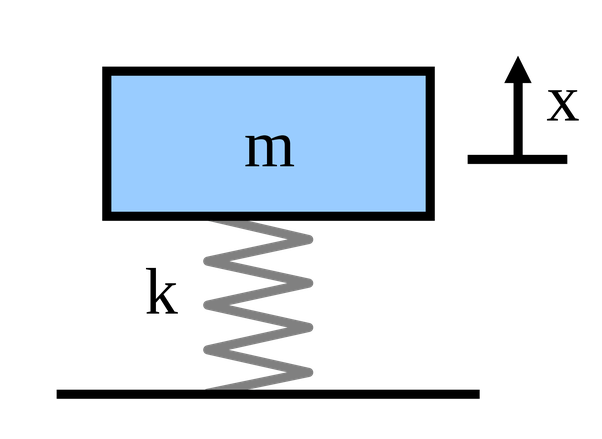
F = √ (k ÷ m) ÷ 2π. I have looked in a couple different textbooks and online and i can't find anything that has this. Write x1 = x(t1) and x2 = x(t2).
But The Question Is Not So Easy, Because They Are Not Giving You K Directly.
The following expression defines the angular frequency: Measuring the natural frequency of the suspension takes away. This video explains how to find natural frequency of vibration in case of spring mass system.
We Also Show The Resonance Behaviour Of The System.
The frequency of simple harmonic motionlike a mass on a spring is determined by the mass m and the stiffness of the spring expressed in terms of a spring constant k ( see hooke's law): The difference of their natural logarithms is the logarithmic decrement: I have looked in a couple different textbooks and online and i can't find anything that has this.
F = Natural Frequency (Hz) K = Spring Rate (N/M) M = Mass (Kg) Mr = Motion Ratio (Spring:wheel) While The Above Formula Itself Is Very Easy To Manage, It Can Be Tedious To Calculate Out Multiple Corner Weights And Multiple Frequencies To See How The Desired Spring Rates Will Change.
We have the further information amplitude = r natural frequency (or circular frequency) = ω 0 (radians per unit of time; Rayleigh’s method the above equation can be used to find an approximate value of the first natural frequency of the system. K is the spring constant for the spring.
Measure Of Rotation Rate) Period Of Motion = T = 2Π/Ω 0 = 2Π/(K/M)1/2 (Time For 1 Full Oscillation) The Dimensionless Parameter Δ/Ω 0
Inserting this product into the above equation for the resonant frequency gives, which may be a familiar sight from reference books. Then the frequency is f = hz and the angular. This formula equals f = sqrt / m * 2* ** n/m (spring constant).
But They Have Told You How The Force Varies, As The Compression Of The Spring Varies.
The components x i = (x i1,x i2) are called ”normal modes”. But i don't know this applies to this question. Ω n = natural angular frequency of spring (rads/s) f n = natural frequency of spring (cycles/s) τ = shear stress (n/m 2) τ i = initial spring stress (n/m 2) τ max = max shear stress (n/m 2) θ = deflection (radians) δ = linear deflection (mm)
Concert At Singapore National Stadium . Buy national stadium with confidence from livenation.sg. The arena was designed by kenzo tange, a renowned japanese architect. Entree Kibbles National Stadium Singapore Chinese from cavinteo.blogspot.sg The national stadium of singapore was officially opened on 21 july 1973 by then prime minister lee kuan yew. The 55,000 capacity national stadium has a retractable seating capability making it the only stadium in the world able to host a multitude of events such as rugby, cricket, football, athletics, concerts, family. Check address, transport & venue details.
Harry Potter Movie Review New York Times . With daniel radcliffe, rupert grint, emma watson, richard griffiths. But is also, like the movie adaptations, a more. Harry Potter and the Cursed Child Broadway REVIEWS from www.express.co.uk An ancient prophecy seems to be coming true when a mysterious presence begins stalking the corridors of a school of magic and leaving its victims paralyzed. Harry potter and the chamber of secrets: ‘harry potter’ back onstage, streamlined and still magical.
Ghostbusters 3 Next Gen . Steve the geek on dts:x blu. Allociné verified account @allocine allociné, le site de référence du cinéma et des séries tv ! squid b0ii YouTube from www.youtube.com Glock gen 3 gen 4 upright display stand. It peaked at number one on the us billboard hot black singles chart for one week and at number two on the billboard hot 100 for three weeks. Makes a difference even on sacds, but not s great deal on regular music cds.



Komentar
Posting Komentar